
Walk into any jewellery store, scroll through Instagram, or browse an online marketplace and you’ll notice something surprising:
most people can’t actually tell the difference between real and fake jewellery.
In fact, multiple industry surveys suggest that nearly 90% of buyers misidentify jewellery at least once — sometimes paying premium prices for imitations, other times overlooking genuine craftsmanship because it doesn’t “look expensive enough.”
So how does this happen?
And more importantly — can you spot the difference?
Table of Contents
Let’s find out.
The Illusion of “Real”: Why Our Eyes Get Fooled
Humans are visual creatures. We judge quality in seconds — by shine, weight, color, and how something makes us feel. Jewellery manufacturers know this well.
Modern imitation jewellery isn’t cheap-looking plastic anymore. Today’s fakes use:
- Advanced plating techniques
- Lab-created stones that mimic natural sparkle
- Precision molds copied from luxury designs
- Marketing language that sounds “almost real”
The result? Jewellery that looks authentic at first glance — sometimes even under close inspection.
But appearance alone is the biggest trap.
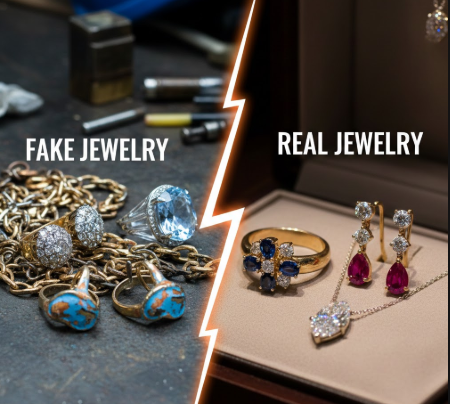
The Jewellery Test: Can You Guess Which Is Real?
Imagine this scenario:
Two identical rings sit on a velvet tray.
- Same size
- Same sparkle
- Same gold tone
One costs $1,200.
The other costs $120.
Which one is real?
Most people guess wrong — because price, shine, and beauty don’t equal authenticity.
Let’s break down why.
What “Fake Jewellery” Really Means (It’s Not Always What You Think)
Before we go further, we need to clarify something important.
Fake jewellery isn’t always “bad” jewellery.
There are three main categories people confuse:
1. Costume Jewellery
- Made with base metals
- Usually not meant to last decades
- Fashion-focused, trend-driven
- Often inexpensive
2. Imitation / Simulated Jewellery
- Uses high-quality alloys
- Plated with gold, silver, or rhodium
- Stones may be cubic zirconia or lab-created
- Designed to look real
3. Fraudulent Jewellery
- Sold as “solid gold” or “natural diamond” but isn’t
- Misleading descriptions
- Inflated prices
- This is where people lose money
This article focuses on spotting the difference between authentic fine jewellery and deceptive imitations, not shaming affordable fashion pieces.
Why Fake Jewellery Looks So Real Today
Technology has changed everything.
Here’s why modern fake jewellery is harder to detect than ever:
🔬 Advanced Stone Cutting
Cubic zirconia and moissanite are cut using the same techniques as diamonds, creating nearly identical brilliance.
⚙️ Precision Manufacturing
CNC molds replicate luxury designs down to the millimeter.
✨ High-Quality Plating
Thick micron plating can last years, maintaining shine and color.
📸 Social Media Filters
Lighting, editing, and angles exaggerate sparkle and hide flaws.
In short: your eyes are no longer enough.
The Biggest Myths About Real Jewellery
Let’s bust some common assumptions that lead people astray.
❌ Myth 1: “Real jewellery is heavier”
Truth: Some high-quality alloys weigh more than gold.
❌ Myth 2: “If it sparkles more, it’s real”
Truth: Diamonds don’t always sparkle like rainbows — that’s often a fake stone.
❌ Myth 3: “Expensive means authentic”
Truth: Many people overpay for plated jewellery sold with luxury branding.
❌ Myth 4: “I can tell by color”
Truth: Gold color varies naturally, and plating can mimic it perfectly.
Real vs Fake Jewellery: The Side-by-Side Breakdown
Let’s compare them properly.
1. Metal: The Foundation of Truth
Real Jewellery
- Solid gold (10K, 14K, 18K)
- Sterling silver (925)
- Platinum
- Naturally resistant to flaking
Fake Jewellery
- Brass, copper, zinc alloys
- Gold-plated or gold-filled
- May tarnish or fade over time
🔍 Expert Tip:
Check for hallmarks inside rings or clasps — but beware: fakes often copy stamps too.
2. Stones: Sparkle Isn’t Everything
Real Stones
- Diamonds have subtle brilliance
- Imperfections under magnification
- Fire appears white, not rainbow-heavy
Fake Stones
- Perfect clarity (too perfect)
- Excessive rainbow sparkle
- Often flawless under a loupe
💡 Truth bomb:
Most people think diamonds sparkle like disco balls — they don’t.
3. Craftsmanship: Where Fakes Slip Up
This is where authenticity reveals itself.
Real Jewellery
- Smooth edges
- Balanced settings
- Secure prongs
- Comfortable to wear
Fake Jewellery
- Sharp edges
- Uneven stone placement
- Loose clasps
- Lightweight feel
Luxury lies in details most people don’t check.
The “Touch Test”: What Your Hands Know Before Your Eyes Do
When customers handle real jewellery, they often say the same thing:
“It feels… different.”
That difference comes from:
- Density of precious metals
- Balance in design
- Smooth finishing
Fake jewellery can look perfect — but it rarely feels perfect.
Why Even Professionals Get Fooled
You might think jewelers never fall for fake pieces. That’s not true.
High-quality imitations can pass:
- Visual inspection
- Basic weight tests
- Casual gemstone checks
This is why professionals rely on:
- Acid tests
- Diamond testers
- X-ray fluorescence
- Lab certification
If experts need tools — why expect consumers to rely on instinct alone?
The Emotional Cost of Getting It Wrong
Buying fake jewellery unknowingly isn’t just a financial loss.
It can mean:
- A proposal ring that isn’t what you thought
- A gift that doesn’t hold its promised value
- A family piece that won’t last generations
- Broken trust in a brand or seller
Jewellery carries emotion. That’s why authenticity matters.
How to Protect Yourself (Without Becoming a Gemologist)
You don’t need expensive tools — just smart habits.
✅ 1. Ask for Certification
Especially for diamonds and fine jewellery.
✅ 2. Read Descriptions Carefully
Words like:
- “Gold tone”
- “Diamond-like”
- “Simulated”
- “Inspired by”
These are legal — but revealing.
✅ 3. Buy From Transparent Brands
Look for:
- Clear material disclosure
- Real photos (not stock images)
- Education-focused content
✅ 4. Trust Brands That Teach You
The best jewellery brands don’t hide knowledge — they share it.